
Thode Door Thode Paas Season 1
Thode Door Thode Paas Season 1 (2025) is a family-oriented story with a clean plot with a light comedic drama. Directed by Pankaj Kapur, Mona Singh, Kunaal Roy Kapur, and Sartaaj Kakkar, it is based on a modern family that has to pull the plug of their TV. According to viewers that visit filmyfly updates, its 2 hours and 29 minutes running time allows the storytelling to be tight, relatable and funny to the viewers across all age groups and demographics across the world.
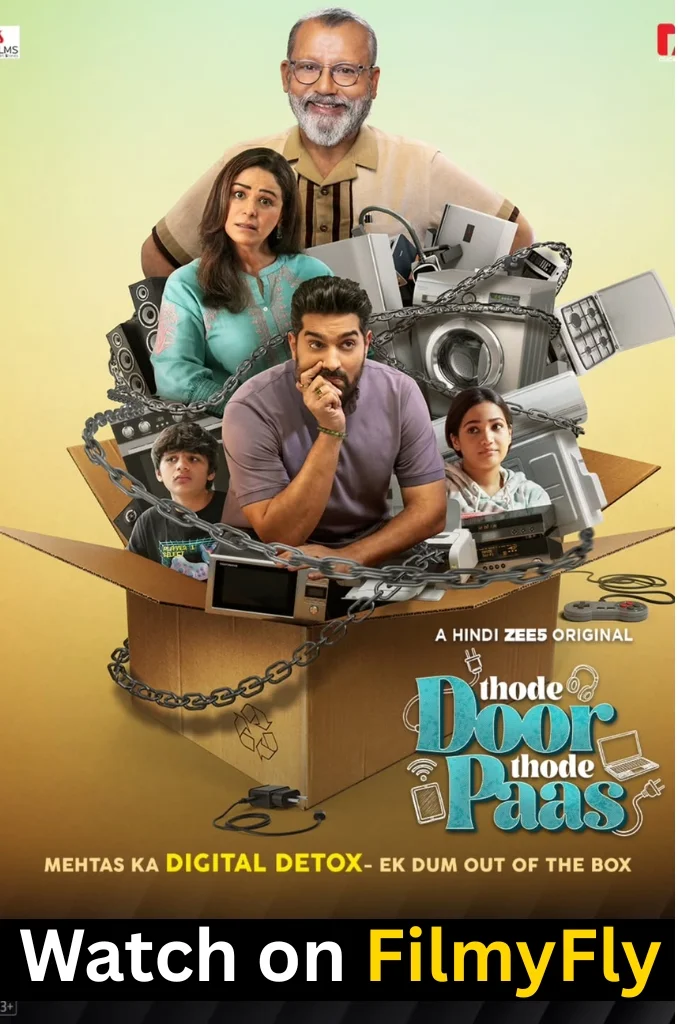
The main idea is that there is an attractive proposal: a huge amount of money in case the family does not use digital devices in six months. This thought brings in the element of the unexpected, which comes out to depict the extent to which technology has become entrenched in day to day life. It is not just a test of discipline but reveals some of the latent habits, emotional calluses and relationships which have to be rediscovered outside the screen.
Storyline Overview
The film starts “Thode Door Thode Paas ” with a story of Ashwin Mehta, played by Pankaj Kapur who feels that technology has led to the destruction of family relations. He puts the stakes high and believes that being offline will push everybody to reconnect in a meaningful manner. This might be a mere bet but the next thing is a life changing experiment which catches all the members out of their comfort zones.
When the family is embarking on the challenge, they face a combination of entertaining and annoying challenges. Communication failures, unsuccessful efforts to adjust, their struggles form an actual image of how reliant individuals are to gadgets. But all these challenges also lead to sincere discussions and emotional recovery. Every minute makes the characters more close, slowly changing their perception of unity.
Characters and Performances
Pankaj Kapur adds a depth and a flair to the character of Ashwin Mehta, who is a stern but loving viewpoint character that is the force behind the story. The fact that he is there gives the series some gravitas to the challenge he poses. Mona Singh has provided a sincere performance of a woman who has to balance as she tries to learn how to operate without digital shortcuts. Her quest is indicative of the stresses of contemporary family life.
The show is full of humor and much of it is contributed by Kunaal Roy Kapur and Sartaaj Kakkar through their contrasting personalities. Kunaal is playing a man who is overly addicted to online entertainment, and Sartaaj is a teenager who is unable to live without social media. Their acts serve as demonstrations of the generational disparities in use of technologies and they produce the scenes that seem to be both funny and surprisingly informative. The cast is believable and interesting together in a family.
Themes and Message
The show is fundamentally about how digital overload defines relationships nowadays. It poses a question of whether technology unites or alienates individuals and delivers a tale that is familiar to nearly all families. The dilemma compels the characters to look inward without the digital distractions and discover their insecurities, distant dreams, and their lack of emotions, they were unaware of.
The story does not preach but makes the audience review their own screen time. It combines light and comedy with some instances of quiet contemplation, demonstrating how true bondage can be founded on such mundane interactions. The show stresses that getting out of technology does not require rejection but restoring the balance. In this message, one is presented with relatable situations as opposed to lectures, making the tone friendly and accessible.
Comedy and Drama Balance
The comedy of the show is in the efforts of the family to get themselves to work offline, lost keys, broken routines, and strange tendency to grab phones which are not there. These scenes are created at their natural time, and they seem like scenarios extracted in real houses. The comedy is never imposed, and the series is as grounded as it can be even in the exaggerated situations.
The play is developed in a slow way with the characters experiencing emotional realities which were initially avoided by technology. Discussions are also richer, the disputes are unveiled, and the personal flaws are addressed. This is a balance between humour and emotional scenes that makes the story interesting. Both the laughter and contemplation are equally felt by the viewers, making the viewing experience very warm and valuable.
Visuals and Direction
The direction is very intimate and comfortable and befits the family theme of the story. The action frequently takes place within the home, and viewers can see the way in which the characters interact. The cinematography is also done in warm colors and natural light that helps create the homely feel, which strengthens the notion of unity outside of the digital screens.
The pacing and sound design hand over to help support the comedic and dramatic tones. The editing is not rushed unnecessarily, allowing the emotional scenes to breathe without ruining the comedy of the moment. All these technical aspects form a seamless watching experience to highlight the simple, but relatable appeal of the show.
Conclusion
Thode Door Thode Paas Season 1 (2025) is one of the touching versions of digital addiction and family life. The series also appeals to the contemporary viewers with its great performances and a rather interesting idea that can be seen in the combination of humor and self-reflection. Its plot can be light, though its message has a serious tone in terms of connection and balance in the modern world dominated by technology.
At the conclusion, the characters find out that the screen is not the only way to stop and realize that there is more to be understood and authentic connections can be made. Their experience underscores the ways in which relationships can be redefined through minor adjustments that have some long-term impact. The series is a great experience to watch with the family, be it because of its feelings or for its comedy.