
Noah
The movie Noah (2014) is an impressive and emotionally rich remake of the ancient tale of the flood, with Russell Crowe playing the role of Noah with a lot of passion and fire. Under the direction of Darren Aronofsky, the movie incorporates spiritual, survival and big screen shots to produce a complete filming experience. It goes further than just an adaptation, touching on ethical questions, divine challenges and the fall of man, and is thus a compelling viewing that can be found scouted on Filmyfly.
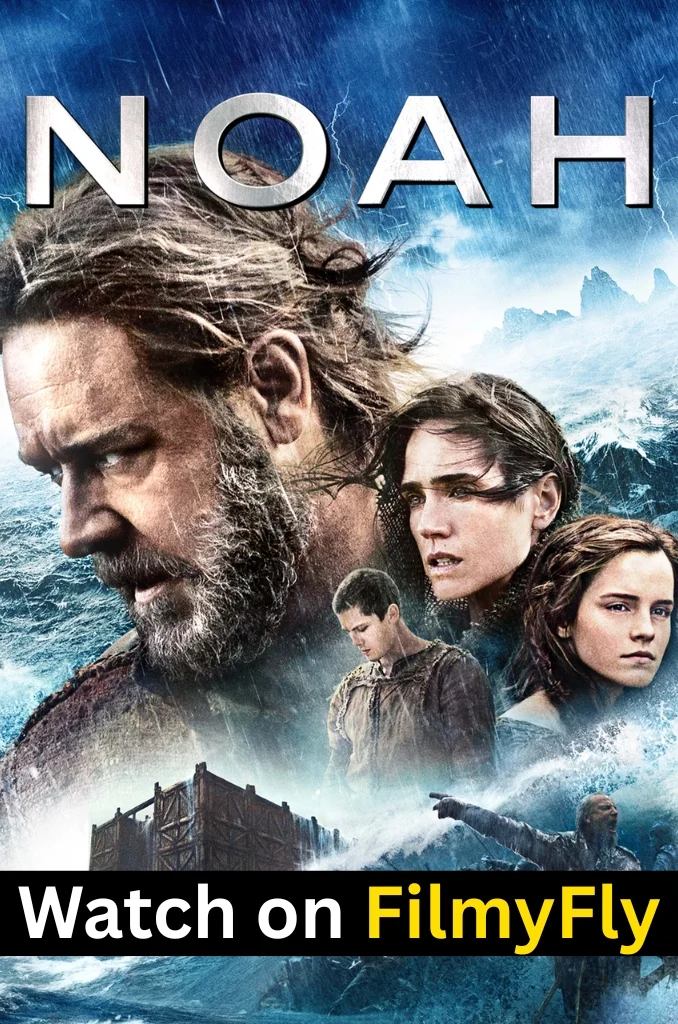
In addition to Crowe, the film also boasts of good performances by Jennifer Connelly, Emma Watson, Logan Lerman, and Anthony Hopkins who all contribute to the emotional depth to the escalating disaster. The movie is both a personal and an epic film as it incorporates both down to earth family battle and a huge scale epic storytelling. Noah is a film that asks its viewers to push the limits of duty, compassion and destiny and provides a new take on an ancient legend.
A Dark, Striking World
The atmosphere of the world of Noah is very gritty and desolate, which is the reflection of corruption that mankind falls into. Aronofsky introduces a landscape that was devastated by war, starvation, and immorality, which is why something has to be done to fix the situation. The film renders people who are on the verge of their downfall with breathtaking shots and well-crafted settings. This bleak environment adds to the emotional strain that Noah is undergoing since he is seeing humanity killing itself.
The visuals are reinforced by creepy sound composition and mythical images, such as desolated wastelands up to soaring storm clouds. The peculiarity of the interpretation of the Watchers in the film gives it a touch of fantasy. These are the giants that look like stones and are voiced by Nick Nolte in part adding to the feeling of losing the harmony of the world. The images are not only a spectacle but a figurative representation of soul conflict, human and divine.
Crowe as the Relentless Noah
Russell Crowe provides one of the strongest performances of his career as Noah torn between a divine vision and his love towards his family and obeying it. His Noah is not a gentile, indeed a passive character; he is a forceful, even terrifying man who feels that he has a holy task to perform at all costs. Crowe conveys the heartache of a man who is called upon to make an impossible choice, which makes the character complex.
This description also shows the mental price of leadership in a world-ending crisis. Noah does not just construct an ark but he is also carrying the future of the world on his shoulders. The play of Crowe depicts an actor who becomes more and more isolated as his understanding of god starts to disagree with the humanitarian spirit and reason. This emotional paradox is one of the motivating forces of the movie and adds dramatic essence to it.
Strong Supporting Cast
A supporting cast is talented and brings the family dynamics in Noah to life. Jennifer Connelly stars as Naameh, the wife of Noah, his devoted wife whose emotional power is the counterpoint of his harshness. Her moments are especially strong throughout the latter conflict, when she challenges his more inflexible ideologies. In the meantime, the sons of Noah are played by loggerhead characters by Logan Lerman and Douglas Booth, who complement each other with the creation of emotional conflicts within the family.
The star Emma Watson is Ila, an adopted daughter whose hopeless desire to find love and safety turns out to be the focus of the ethical issues of the movie. Her act brings softness and weakness to the mean world that surrounds her. Anthony Hopkins (Methuselah) adds some bit of wisdom to his short yet effective scenes with a touch of mystical appeal. The ensemble brings the story to its knees through a down-to-earth emotional performance and unforgettable screen presence.
Faith & Moral Conflict
The core of “Noah” is the consideration of faith and morality and the responsibility of decoding the divine will. The movie does not make Noah a perfect person; it depicts him struggling with the interpretation of the visions that he has. This interpretation takes him in the wrong direction and the audience is left to wonder can righteousness become fanatical. This ethical complication distinguishes the movie as compared to the other less complicated versions of the flood story.
Mercy, justice and human value are also issues addressed in the movie. The plot of Ila, as well as the inner issues of the sons of Noah, has highlighted the importance of love and decision in the middle of destruction. The question that the film poses is: is destiny predetermined or determined by compassion by taking the spiritual responsibility and blending it with the human emotion. These superimposed themes render Noah an intellectually stimulating experience to the viewers of the current age.
Building the Ark
The scene in the film that stands out the most is the building of the giant ark which was constructed as per the divine visions of Noah. The size of the ship indicates the magnitude of the mission as well as the desperation of the mission. The filmmakers apply both practical sets and digital additions to make the ark come to life in amazing detail. The construction work turns into a visual metaphor of the final hope of human beings and the burden of the responsibility of Noah.
It is also an epic project which gives stress on unity and the strength of the family of Noah though there are increasing conflicts between them. Watcher is a significant character as he assists in building the ark and this mixture of myth and fantasy is a bonus to the storytelling. These scenes help to emphasize that human struggle combines with supernatural forces, which demonstrate that the world-changing event is about to take place.
The Devastating Flood
The chain of events in the flood is not only spectaculously pleasing to the eye, but also heart-rending. The huge waves, the storming waves and the desperate masses make people feel the sense of great devastation. Aronofsky does not glorify the spectacle, he introduces the spectacle as a sad, horrifying verdict on the sins of humankind. This method adds to the gravity of the mission of Noah, the tragedy of a world lost to its own violence.
The emotional burden is even stronger within the ark. Trapped in the darkness and the lack of any certainty, the family of Noah experiences fear, guilt, and the burden of survival. Some of the best scenes in the book are brought by Jennifer Connelly and Emma Watson, who display the desperation and tension between life, hope, and the strictness in the beliefs of Noah in this part. These scenes contribute to the fact that a mythic event becomes more human.
Conclusion
Noah (2014) is not the traditional version of the Bible; it is a bold filmic adaptation that deals with the issue of complexity of faith, leadership, and human character. The movie is emotionally rich with a powerful acting of Russell Crowe and the good support of Jennifer Connelly, Emma Watson and Logan Lerman. The direction by Aronofsky presents a particular mixture of the realistic and mythical, establishing a world that seems to be old and cruel and terrifyingly symbolic.
Regardless of considering it as an epic adventure or a psychological drama, Noah is a film that is ready to defy the norms. It is a familiar story to most people, but with contemporary questions of morality and destiny. An impressive performance, beautiful imagery, and provocative messages make Noah one of the films that are difficult to forget because it is an amazing film experience that penetrates the soul of humanity and mystery of God.