
Mirai
Mirai (2025) delivers a refreshing fusion of history, mythology, and futuristic fantasy, creating an ambitious benchmark for South Indian sci-fi cinema. Led by Teja Sajja, the film features Rana Daggubati, Manchu Manoj, and Shriya Saran in powerful roles. Its bold attempt to merge ancient Indian folklore with fast-paced fantasy storytelling makes it stand out, attracting viewers searching for epic concepts on filmyfly.
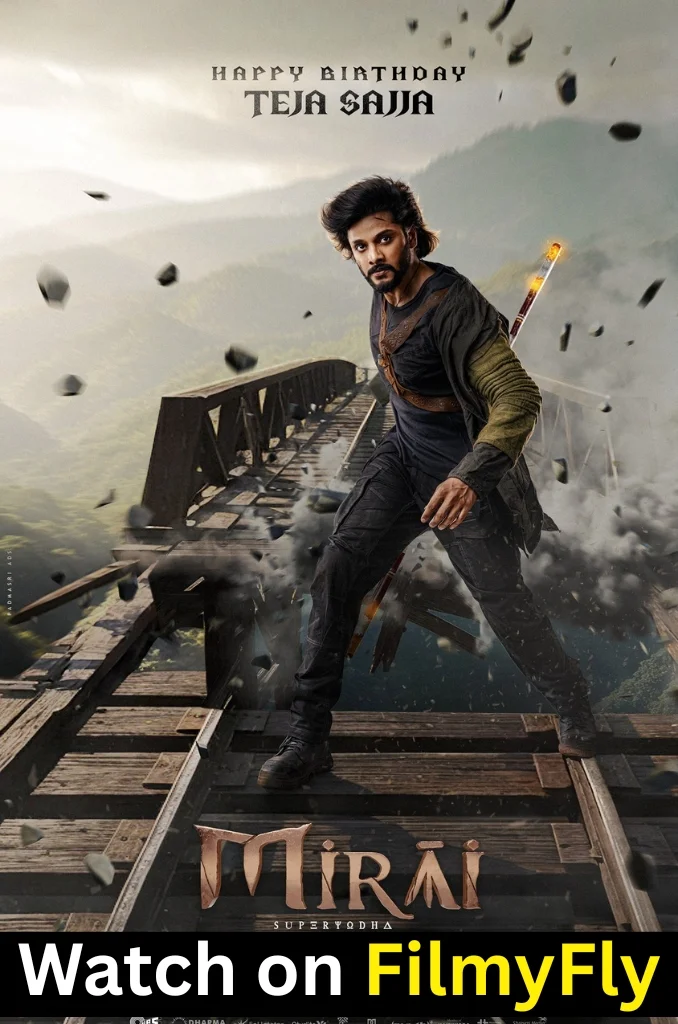
The setting of this movie is time-travelling and how the past affects the present and the future. The movie is based on the events following the legendary battle of Kalinga whereby the discovery of lost information in ancient texts can result in inexplicable magic. The plot takes the audience through the kingdoms, warriors, mystic secrets, and emotionally-colored clashes, so Mirai is not only an action spectacle, but a profound character journey.
Storyline Overview
The story starts with the legendary Kalinga war in which King Ashoka comes out to triumph but later swears off violence after seeing its atrocities. He steers the course of peace rather than increasing his empire by violence. Yet, behind this change there is a secret of nine select warriors, who were commissioned to safeguard antique textbooks, which were known to have godly knowledge that could turn any individual to be godly.
The story is then transferred centuries later to the contemporary times where new threats emerge, and they want to get their hands on these rare scriptures in order to have selfish motives. The movie traces the path of the main character played by Teja Sajja who is sucked into this gigantic fight between good and evil. Gradually discovering the facts about the so-called Nine Guardians, he gets himself involved in a much bigger fate, which connects history, myths, and the future.
Character Performances
The performance of Teja Sajja is powerful and emotionally supported, both naive, courageous, and fateful. His personality turns a non-ordinary brave young man into a defender of the ancient secrets. The intensity of their roles by Rana Daggubati and Manchu Manoj provides the story with its power play and the drama of tension of high stakes. Every actor is playing with the conviction towards the world-building of the film.
The supporting actors and actresses such as Shriya Saran, Jayaram, Jagapati Babu and Raj Zutshi take the drama to the next level with straddling performances. Their positions bring interest to the story by the manifestation of various ideologies, loyalties, and the people’s motives. Ritika Nayak is a newcomer in the film employing her grace to make the film fresh and Prabhas special appearance makes the storyline bigger and more star-like.
Themes & Symbolism
The thematic depth of “Mirai” is one of the most powerful aspects. The movie presents the use of power, in combination with human ambition, which can be used to ruin civilizations, or to save them. The responsibility that follows knowledge is brought out in the story by a referral to the nine warriors of Mauryan history. It is allegorical, and represents the clash between peace and supremacy and resembles the personal transformation Ashoka experienced following the Kalinga war.
The other significant theme is free will and destiny. The main character repeatedly doubts whether he is selected by destiny or he is just dragged into some situation which he cannot control. It is also in the movie that one can see the importance of safeguarding the past and realizing the meaning behind ancient teachings. All these symbolic layers render “Mirai” more than a typical sci-fi adventure, as it has a touch of emotional and philosophical depth to it.
Action & Sci-Fi Elements
Mirai is a brilliant film with its imaginatively produced action scenes which mix up martial arts, use of weaponry and the application of futuristic technology. High-energy stunt choreography, smooth wire-work, and creative set pieces have been used in the film to bring impressive visual battles. The combats between the Nine Warriors are especially interesting in the sense every warrior possesses his/her a priori style that he/she takes after historic portrayals and mythological qualities.
In the sci-fi front, the film shows the world where ancient manuscripts will interact with modern science. Ideas, such as sources of energy, transformational capacities, and power channels that are time-specific, introduce novelty to the story. The visual effects crew makes sure that the futuristic details are believable and real. This blend of mythology and science fiction provides a unique experience in the Indian cinema that is not prevalent in the sector.
Technical Aspects
Mirai has a good team of technical staff that favours its ambitious size. Wide landscapes, old temples and new battle grounds are all equally finely captured using the cinematography. The color changes and the lighting change gradually and transitions through various eras, allowing the viewers to track the timeline. The background music is intense and, particularly, in the scenes involving spiritual and action, the emotional effect of the film is enhanced.
The visual effects (VFX) are very important in the interpretation of the mythical-scientific universe. The design team in production also has to be credited with creating elaborate sets of both the past and futuristic setting. The long runtime does not make editing dull, with a great deal of momentum in major story arcs. The film is in general well-finished, full, and pleasing to the eye during the 2 hours 46 minutes of its time span.
Conclusion
Mirai is a special mixture of mythology, science fiction, and epic drama. It provides thrilling scenes as well as providing emotionalism, allegorical undertones, and a clear-cut plot. The move of the film to re-write ancient Indian history in a contemporary film language is refreshing and daring. It manages to build a recognizable and imaginative world with great performances and amazing visuals.
The movie has a lot to show to every viewer whether you are fond of historical stories, science-fiction, or just the character-development epics. The film offers scale, plot, and show and thus it is an interesting addition to the changing face of South Indian film. It is a movie that is worth viewing in its uncut Hindi + Telugu dual-audio version by those who enjoy the big-screen fantasy experience.